
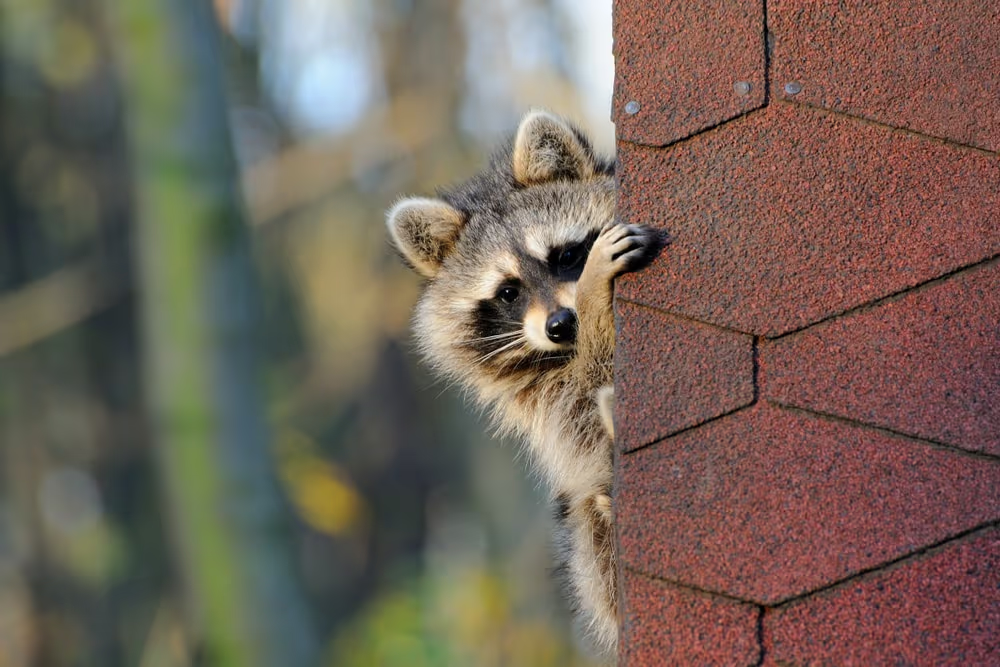
Raccoons and Squirrels Are Denning in Surrey Attics Right Now — Here’s How to Tell
Scratching overhead in autumn usually means a raccoon or a squirrel has moved into your attic to den for winter. Squirrels are active at dawn and dusk and make light, fast scurrying sounds. Raccoons are nocturnal and heavy — you will hear thumping, dragging and vocalisations. Both cause insulation and contamination damage, and both require exclusion rather than trapping alone.
Between September and November, Surrey households start hearing something above the ceiling. It is rarely imagination, and it is rarely a one-night visitor. Autumn is when Metro Vancouver’s raccoons and squirrels stop treating attics as an option and start treating them as winter accommodation.
The distinction matters, because the two animals need different handling, carry different legal constraints, and cause different kinds of damage.
How do you know if it is a raccoon or a squirrel in your attic?
You can usually identify the animal from sound alone, before anyone goes into the attic.
Squirrels — most often eastern grey squirrels in Surrey, and occasionally native Douglas squirrels:
- Active at dawn and dusk, quiet overnight
- Light, rapid scurrying and scampering; the sound moves quickly and changes direction
- Rolling or dropping noises — cached nuts moving across the ceiling joists
- Persistent gnawing, since their incisors grow continuously
- Entry holes roughly 5–6 cm, often at the roofline or a gable vent
Raccoons — considerably larger and considerably more destructive:
- Strictly nocturnal; activity starts after dark and peaks late
- Heavy, deliberate thumping. People routinely describe it as sounding like a person
- Dragging sounds as insulation and material are moved to build a den
- Vocalisations — chittering, growling, and in spring the distinctive chirring of kits
- Entry points 10–20 cm, frequently a torn soffit, a lifted roof vent, or a pried fascia board
Rats are the third possibility and are often mistaken for squirrels. Rats run at night, make lighter and faster sounds than raccoons, and tend to move within wall cavities rather than across the open attic floor. If the sound is in the walls rather than overhead, see our guidance on rat-proofing a Vancouver roofline.
Why do raccoons and squirrels move into Surrey attics in the fall?
Two pressures converge in September and October.
The first is weather. Coastal BC does not deliver the hard freeze that drives denning behaviour elsewhere in Canada — what drives it here is rain. Once sustained autumn rainfall starts, an outdoor den in a hollow tree, a brush pile or under a deck becomes wet and stays wet. A dry, insulated attic at a stable temperature becomes disproportionately attractive by comparison.
The second is the breeding calendar. Female raccoons select and secure a winter den site in autumn, and that same site is frequently reused for a spring litter in February and March. This is the origin of a common and expensive mistake: an autumn raccoon that is tolerated becomes a spring family, at which point removal is slower, more complex, and legally constrained by the presence of dependent young.
Surrey’s housing stock adds a third factor. Large areas of the city combine single-family homes with mature tree canopy, wood-framed construction and generous soffit and roof-vent detailing — a combination that gives climbing animals both the access route and the entry point. Cloverdale, Fleetwood and South Surrey’s older established neighbourhoods tend to generate the most attic wildlife calls.
Where do they actually get in?
Almost always at roof level, and almost always at a junction rather than through solid material.
- The soffit-to-fascia junction — the single most common raccoon entry. A raccoon hanging from the gutter can apply real force to the soffit’s leading edge
- Roof vents and turbine vents — plastic housings are easily pried or chewed
- Gable and attic vents — screening is often thin aluminium mesh that fails quickly
- Where the roofline meets a dormer, chimney or an addition — flashing gaps at these joins are a standard squirrel entry
- Rotten or water-damaged fascia, which yields to very little pressure
- Plumbing stack and vent boots where the rubber has perished
The access route matters as much as the hole. Overhanging branches, fences that run to the house, ivy on the wall, downspouts and hydro lines all deliver an animal to roof level. Sealing the hole while leaving the ladder in place tends to produce a new hole.
What damage do raccoons and squirrels actually cause?
This is where the real cost sits, and it is consistently underestimated because none of it is visible from the ground.
Insulation
The most immediate and expensive loss. Raccoons flatten, compress and physically tear out batt insulation to clear a den chamber, and both species trample loose-fill insulation into a compacted layer. Compressed insulation loses most of its effective R-value, so the damage shows up as heating cost through the winter. A raccoon denning in an attic through one season can compromise a substantial portion of the insulated area.
Contamination
Raccoons establish latrine sites — repeated defecation in one location, usually a corner. Urine and faeces saturate insulation, soak into drywall and framing, and produce persistent odour that survives ordinary cleaning. There are two specific health considerations:
- Raccoon roundworm (Baylisascaris procyonis) — eggs are shed in faeces, become infective after a period in the environment, and are notably resilient. This is the principal reason raccoon latrine cleanup is not a DIY task.
- Leptospirosis, transmissible through urine-contaminated material.
Squirrels do not establish latrines in the same concentrated way, but urine saturation of insulation over a season still produces odour and contamination.
Structure and wiring
Squirrels gnaw continuously as a physiological necessity, and electrical cable is a frequent target. Chewed wiring inside insulation is a genuine fire risk and is difficult to detect before failure. Both species damage vapour barrier, ductwork and stored contents, and raccoons routinely widen their own entry hole, converting a manageable repair into a structural one.
Secondary infestation
An occupied attic attracts a second wave. Raccoon and squirrel nesting material supports fleas, ticks and mites, and these do not remain in the attic once the host animal leaves. A wildlife removal that ignores the nest material frequently produces a flea problem three weeks later.
Are raccoons in the attic dangerous?
Honestly assessed: they are a property and sanitation problem far more than a direct physical threat.
Raccoons are intelligent, dexterous and neophobic — they generally avoid confrontation and will retreat given an exit. The genuine risks, in order of likelihood:
- Contamination — roundworm and leptospirosis, as above. Real, and the reason cleanup is specialised work.
- Defensive aggression — uncommon, but a cornered raccoon, or a mother with kits, will defend. This is why nobody should be crawling into an attic to confront one.
- Rabies — in British Columbia, rabies is almost exclusively a bat-associated virus. Raccoon-variant rabies is not established in BC. Any bite still warrants immediate medical attention, but the widespread assumption that raccoons here are rabid is not supported.
Squirrels present a lower health risk overall, but a higher fire risk through wire gnawing.
What you should not do
Several common responses make the situation materially worse, and two of them carry legal consequences.
- Do not seal the entry hole first. If young are present, sealing traps them inside, where they die in an inaccessible cavity. Beyond the animal welfare issue, the resulting odour and contamination problem is severe and often requires opening ceilings.
- Do not relocate wildlife yourself. Under the BC Wildlife Act, live-trapping and relocating wildlife is regulated, and moving animals off-property is broadly not permitted for unlicensed individuals. Relocated raccoons also have poor survival rates and frequently return.
- Do not use poison. It is illegal for wildlife in this context, it kills the animal inside the structure where you cannot retrieve it, and it poses secondary risks to pets, children and non-target species.
- Do not rely on repellents. Ammonia rags, ultrasonic devices, radios and predator urine all circulate widely and none reliably displace a denning animal that has already committed to a site.
- Do not clean a latrine without protection. Roundworm eggs are resilient and become airborne on dry material.
How professional attic wildlife removal works
The sequence matters, and it is the same in principle for both species.
- Full inspection — identify the species, locate every entry point (there is usually more than one), and critically, determine whether dependent young are present. This governs everything that follows.
- Humane eviction — a one-way door is fitted over the primary entry, allowing the animal to leave and preventing re-entry. Where kits are present, they are removed by hand and placed so the mother can retrieve them, or the eviction is timed to their mobility. This is the step that distinguishes wildlife control from pest control.
- Exclusion — all entry points are sealed with materials that resist chewing and prying: heavy-gauge galvanised mesh, structural repair to compromised soffit and fascia, and reinforced vent covers. Ordinary screen and expanding foam do not hold against a raccoon.
- Sanitation — removal of contaminated insulation and nesting material, treatment of latrine sites, and deodorising. This is not cosmetic: residual scent marks the site as a viable den for the next animal.
- Prevention — trimming access routes, securing bins, and addressing the conditions that made the property attractive.
Our attic and wildlife removal team in Surrey handles this sequence end to end, and the same service runs across Vancouver, Burnaby and Langley.
How do you keep them out next year?
Once the attic is empty and sealed, the work that keeps it that way is mostly outdoors.
- Trim branches back at least 2.5 metres from the roofline — squirrels jump further than most people assume
- Remove ivy and climbing vegetation from walls; it is a ladder and it hides the damage it causes
- Fit chimney caps and metal vent guards rated for wildlife, not standard insect screen
- Secure green bins and compost — Surrey’s organics collection is a reliable raccoon food source when bins are not latched
- Bring pet food indoors and clear fallen fruit
- Inspect the roofline each spring and autumn, paying attention to soffit edges and vent housings
- Address roof leaks promptly — soft, water-damaged fascia is the easiest entry point on any house
Frequently asked questions
How do I know if it is a raccoon or a squirrel in my attic?
Timing and weight. Squirrels are active at dawn and dusk with light, fast scurrying sounds. Raccoons are strictly nocturnal and heavy, producing thumping and dragging noises often described as sounding like a person moving around.
Are raccoons in the attic dangerous?
The main risks are contamination-related — raccoon roundworm and leptospirosis from latrine sites — rather than direct attack. Raccoons avoid confrontation unless cornered or defending young. Rabies in BC is overwhelmingly associated with bats, not raccoons.
Can I remove a raccoon from my attic myself?
It is not advisable and is legally constrained. Under the BC Wildlife Act, trapping and relocating wildlife is regulated. Sealing an entry point without confirming whether young are present traps them inside, which creates a far worse problem.
How much does attic animal removal cost in Surrey?
It depends on the species, the number of entry points, whether young are present, and the extent of insulation contamination. An inspection establishes the scope before any work is quoted — eviction and exclusion on a single clean entry point is a very different job from a contaminated attic requiring insulation replacement.
Will they come back after removal?
Not if the exclusion is done properly and the site is deodorised. Re-entry almost always indicates a missed entry point or residual scent marking the location as a viable den.
When is the worst time to discover a raccoon in the attic?
February through May, when kits are present and immobile. This is exactly why an autumn denning raccoon should be dealt with in autumn — the same animal in the same attic is a significantly larger job in spring.
Pest Control Services

HomeStars Best of the Best Award Winner