
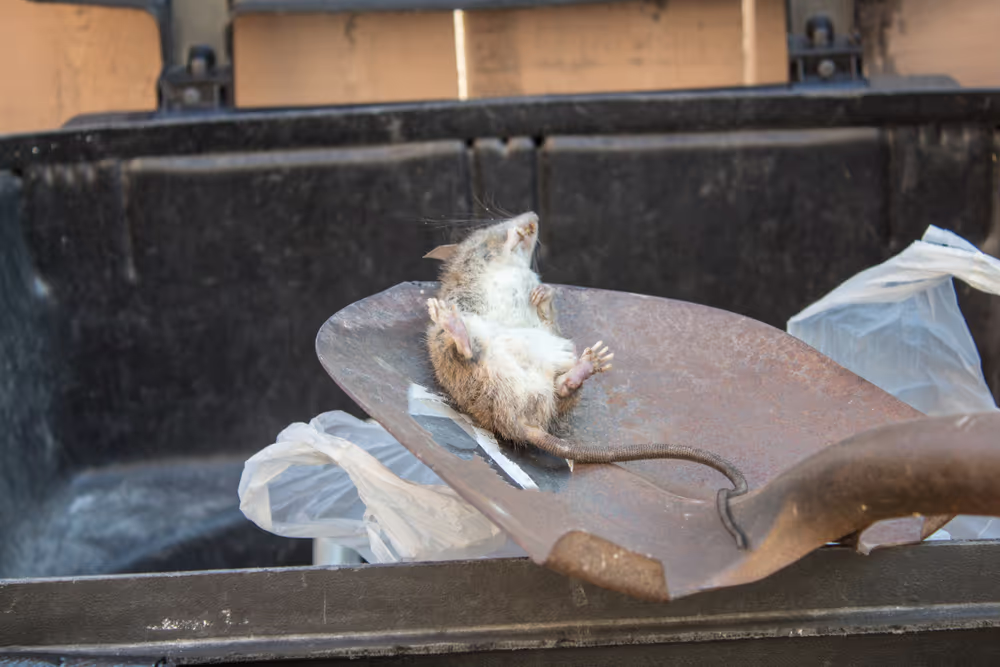
Roof Rats in Vancouver: How to Rat-Proof Your Roofline Before the Fall Rains
Roof rats climb into Vancouver attics from trees, ivy and utility lines, usually entering at roof level rather than ground level. They move indoors when sustained autumn rain begins, typically late September. Rat-proofing means cutting the climbing routes and sealing roofline gaps larger than 12 mm — repellents such as peppermint oil, mothballs and ammonia do not displace an established population.
Most rodent-proofing advice tells you to check the foundation. In Vancouver that advice is half a house too low.
The Lower Mainland has a substantial roof rat population — Rattus rattus, also called the black rat or ship rat — and it is a climbing animal. It enters buildings at roof level: through soffit gaps, vent housings, and the junctions where a roofline meets a dormer or an addition. A homeowner who has sealed every gap around the foundation and is still hearing movement overhead has usually secured the wrong storey.
What is a roof rat, and how is it different from a Norway rat?
Metro Vancouver has both, and they behave differently enough that identification changes what you do.
Roof rat (Rattus rattus)
- Slender, 15–20 cm body, with a tail longer than the body
- Large ears and eyes, pointed muzzle
- An excellent climber — moves along branches, fences, ivy, cables and downspouts
- Nests high: attics, upper wall voids, roof spaces, and outdoors in dense vegetation, blackberry thickets and ivy growth
- Prefers fruit, nuts and plant material
Norway rat (Rattus norvegicus)
- Heavier and stockier, 20–25 cm body, with a tail shorter than the body
- Small ears, blunt muzzle
- A burrower rather than a climber
- Nests low: sewers, crawlspaces, under sheds and decks, in ground burrows
The quick field test is the tail. Lay it back along the body — if it reaches past the nose, it is a roof rat. If the noise in your house is above you rather than below you, it is very likely a roof rat regardless of what you saw in the garden.
Why do roof rats move indoors when Vancouver’s rains start?
This is where most national advice misleads Lower Mainland homeowners.
In most of Canada, rodents move indoors ahead of a hard freeze. Metro Vancouver rarely delivers one. Our winters are mild and wet, and roof rats remain active outdoors year-round — they do not hibernate and they are not driven inside by cold.
What drives them inside here is water. When sustained autumn rainfall begins, typically in the second half of September, outdoor harbourage degrades quickly. Blackberry thickets, ivy masses, woodpiles and under-deck voids become saturated. A dry attic, insulated and stable in temperature, becomes the best available option within a very short window.
Two practical consequences follow:
- The seasonal window is earlier than people expect and is tied to rainfall rather than temperature. Work completed by late September is preventive. The same work in November is remediation of an established population.
- Vancouver’s rat pressure does not stop in spring. Populations persist year-round; autumn is when they relocate. Sealing in autumn addresses the movement, not a seasonal die-off that never happens here.
Properties backing onto greenbelt, ravine or park land — much of North and West Vancouver, and the ravine-adjacent parts of East Vancouver and Burnaby — carry consistently higher pressure because the outdoor population next door is larger.
How do roof rats get onto your roof in the first place?
Before sealing anything, establish how the animal reaches roof level. Sealing entry points while leaving the access routes intact produces a new entry point, usually within weeks.
The routes, in rough order of frequency in Metro Vancouver:
- Overhanging branches. Roof rats jump horizontally around 1.2 m and drop considerably further
- Ivy and climbing vegetation on walls and fences — a continuous vertical highway that also conceals the damage beneath it
- Fences and trellises running to or abutting the structure
- Downspouts and rainwater leaders, which a roof rat climbs easily
- Utility and hydro lines — rats travel these confidently
- Stacked materials against the wall: firewood, lumber, bins, patio furniture
How to rat-proof your roofline: the checklist
This is the practical sequence. Work top-down, and do the access routes before the seals.
1. Cut the climbing routes
Trim all branches to at least 1.2 m clear of the roof and walls — 2 m is safer. Strip ivy from walls entirely rather than cutting it at the base; the dead mat remains climbable. Fit smooth metal guards to downspouts, and move woodpiles and stored materials away from the building.
2. Find every gap larger than 12 mm
A roof rat passes through an opening about the size of a Canadian quarter — roughly 12–15 mm. Inspect, ideally from a ladder in daylight:
- The soffit-to-fascia junction along the full perimeter
- Every roof vent, turbine vent and gable vent housing
- Where the roofline meets a dormer, chimney, or an addition of different age
- Plumbing stack boots where the rubber has perished
- Roof-mounted equipment penetrations
- The gap behind gutters where fascia has rotted
Grease marks, gnaw damage at gap edges, and droppings on the soffit or in the gutter all indicate an active route.
3. Seal with materials that resist gnawing
Rodent incisors defeat foam, standard screen, plastic and wood. Use:
- Galvanised hardware cloth, 6 mm mesh, cut oversize and fastened — not pressed in
- Sheet metal or aluminium flashing for larger structural gaps
- Stainless steel wool packed into irregular voids, then sealed over
- Structural repair for rotten fascia and soffit — sealing over soft wood achieves nothing
Expanding foam alone is not a rodent seal. It is acceptable only as a finish over mesh.
4. Screen the vents properly
Roof, gable, soffit and crawlspace vents are the most consistently under-protected points on a Vancouver house. Standard insect mesh fails immediately. Replace with galvanised hardware cloth behind the existing louvre, secured on all edges. Fit a proper chimney cap if there is none.
5. Remove the food and water supply
Roof rats are drawn to fruit and plant material more than to refuse. Harvest or clear fallen fruit — plum, apple and fig trees are common Lower Mainland attractants. Secure green bins and compost, bring pet food indoors overnight, clean under bird feeders, and fix dripping outdoor taps.
6. Confirm the attic is empty before you seal it shut
This is the step most DIY attempts miss, and it is the one that turns a rodent problem into a worse one. Sealing a fully occupied attic traps rats inside, where they die in inaccessible cavities. Where activity is already established, exclusion must follow removal — not precede it.
Do peppermint oil, mothballs and ammonia keep roof rats away?
No, and this is worth being direct about because these remedies circulate constantly.
- Peppermint oil — rats find the scent aversive at high concentration, but it dissipates within days and does not displace a rat from an established nest with food and shelter. It redirects at best, and only briefly.
- Mothballs — the naphthalene concentration required to repel a rat far exceeds what a household can safely produce. In practice, mothballs in an attic create a human inhalation hazard while the rats continue.
- Ammonia — the theory is that it mimics predator urine. Rats habituate quickly, and the fumes are hazardous in an enclosed roof space.
- Ultrasonic devices — repeatedly tested and not shown to produce lasting population reduction. Rodents habituate within days.
The underlying reason all of them fail is the same: a rat that has found a dry, warm, defensible nest with a food supply nearby is not making a marginal decision that a smell will overturn. Physical exclusion works because it removes the option rather than trying to argue with it.
What happens if you leave a roof rat population in place?
The damage compounds, and most of it is invisible until it is expensive.
- Electrical. Rats gnaw continuously and cable insulation is a common target. Chewed wiring inside insulation is a recognised fire risk and is difficult to detect before failure.
- Insulation and structure. Nesting shreds and compresses batt insulation, reducing R-value and raising heating cost. Vapour barrier and ductwork are commonly damaged.
- Contamination. Urine and droppings saturate insulation and produce persistent odour. Rodents in BC are associated with hantavirus, leptospirosis and salmonella — dry droppings disturbed during cleanup can aerosolise, which is why contaminated insulation removal is protective work rather than casual tidying.
- Population growth. A pair can produce several litters a year. An autumn entry becomes a spring colony, and the cost of resolution scales accordingly.
When exclusion is not enough
Seal-only works when you have caught the movement before occupation. Bring in professional help when:
- You are hearing sustained activity — exclusion alone will trap animals inside
- Droppings, gnaw damage or nesting material are visible in the attic
- Entry points are at height or otherwise unsafe to reach
- The property backs onto greenbelt or ravine, where outside pressure is continuous and one-time sealing is rarely durable
- Insulation is already contaminated and needs removal rather than cleaning
Our rodent control service in Vancouver covers roof rats as well as mice, including roofline inspection, exclusion and contaminated insulation removal. The same work runs in North Vancouver, West Vancouver and Burnaby, where tree cover and ravine adjacency keep roof rat pressure high year-round.
If the noise is overhead but heavier and strictly nocturnal, you may be dealing with a raccoon rather than a rat — our guide to attic wildlife in Surrey and Metro Vancouver covers how to tell them apart.
Frequently asked questions
How do I know if I have roof rats or Norway rats?
Check the tail and the location. A roof rat’s tail is longer than its body and it nests high — attics, upper wall voids, dense vegetation. A Norway rat has a shorter tail and burrows at ground level. Noise above the ceiling almost always means roof rats.
What size gap can a roof rat get through?
Roughly 12–15 mm — about the size of a quarter. Any roofline gap larger than that should be treated as a viable entry point.
When should I rat-proof my roof in Vancouver?
Before sustained autumn rain begins, ideally by late September. Rainfall rather than cold drives roof rats indoors here, because it saturates the outdoor harbourage they would otherwise use.
Does peppermint oil keep rats away?
Not durably. Rats find it aversive briefly, but it dissipates within days and will not displace an established nest. Physical exclusion is the only reliable approach.
Can I seal my attic myself if I can hear rats in it?
No. Sealing an occupied attic traps the animals inside, where they die in inaccessible cavities and create an odour and contamination problem that often requires opening ceilings. Removal must come before exclusion.
Do roof rats go away in winter in Vancouver?
No. The Lower Mainland’s mild, wet winters allow year-round activity. Autumn is when they relocate indoors, not when the population declines.
Pest Control Services

HomeStars Best of the Best Award Winner