
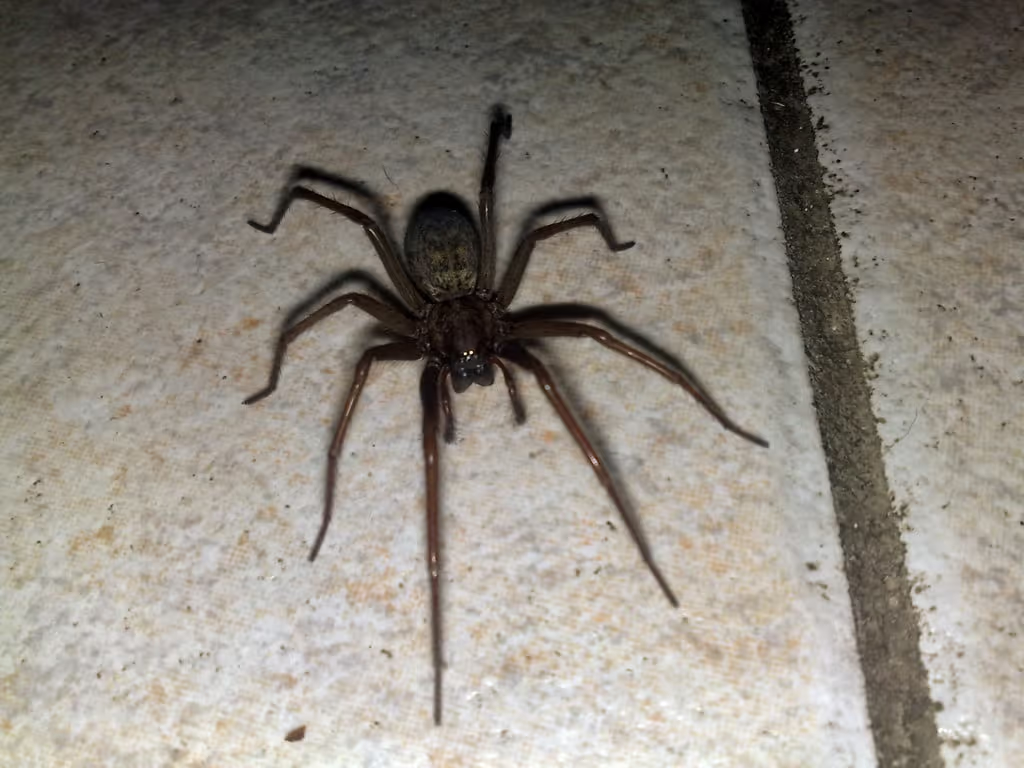
Giant House Spiders in BC: Why They Appear in Vancouver Homes Every September
The giant house spider (Eratigena duellica) is the largest spider most British Columbians will ever find indoors, with a leg span reaching 7–10 cm. It appears in Vancouver homes from late August through October because mature males leave their webs to search for mates. It is not aggressive, not medically dangerous, and it is not a hobo spider.
If you have found a large brown spider sprinting across your living room floor after dark this month, you are not dealing with an infestation. You are watching a mating season.
Every September, Metro Vancouver households encounter the same visitor: a fast, long-legged, brown spider that seems to appear from nowhere, usually at night, usually at floor level. The sightings spike sharply for six to eight weeks, then stop almost entirely. Understanding why that happens is the difference between a reasonable response and an unnecessary one.
What exactly is the giant house spider?
The giant house spider is BC’s largest common indoor spider. Body length runs about 12–18 mm, but the legs are what people notice — a mature female’s leg span can approach the width of a coffee mug, and males, though smaller-bodied, have proportionally longer legs.
They are uniformly brown to greyish-brown, often with faint darker chevron markings on the abdomen. They build flat, messy sheet webs with a funnel-shaped retreat at one edge, typically in a corner, behind stored boxes, under a workbench, or in the gap behind a basement stair stringer.
Two things about them matter more than their size. First, they are among the fastest spiders in North America over short distances, which is precisely why they seem alarming — a spider that bolts reads as aggressive even when it is fleeing. Second, they are a significant predator of other household insects, including the ones people genuinely do not want.
Why do giant house spiders appear in September and October?
This is the single most useful thing to understand, because it explains both the timing and the fact that the problem resolves itself.
Giant house spiders reach maturity in late summer. Mature males then abandon their own webs entirely and begin wandering to find females, who stay put in their retreats. A wandering male has no web, no fixed territory, and no reason to avoid open floor — so he crosses hallways, drops into bathtubs and sinks he cannot climb out of, and ends up under furniture.
The spiders you see in September were almost certainly already living in or around your home through the summer. They did not come in from the cold — spiders are ectothermic and gain nothing from your heating. They became visible because their behaviour changed.
Coastal BC extends this window compared to the rest of Canada. Our mild, damp autumn keeps insect prey available later in the season, which supports spider populations well into October and sometimes November. In a Vancouver, Burnaby or North Shore home with a crawlspace or an unfinished basement, that window can run longer still.
Is a giant house spider the same as a hobo spider?
No — and this is the most consequential identification question in BC, because the two are genuinely difficult to tell apart and one has a far worse reputation than it deserves.
Both belong to the same genus (Eratigena), both build funnel webs, and both are brown with similar markings. The reliable distinctions are:
- Size. The giant house spider is noticeably larger. A spider with a leg span over about 5 cm is almost certainly a giant house spider, not a hobo.
- Leg banding. Hobo spiders have uniformly coloured legs. Giant house spiders often show faint darker rings near the joints.
- Location. Giant house spiders dominate indoors in the Lower Mainland. Hobo spiders are more common in outdoor and ground-level settings and are less frequently found upstairs.
Positive separation of the two requires magnification of the pedipalps or the abdominal pattern — which is to say that no one should be identifying a hobo spider from a phone photo taken at arm’s length. It is also worth stating plainly: the medical reputation of the hobo spider has been substantially walked back over the last two decades, and Health Canada does not list it among spiders of medical significance in this country.
If you have a spider you genuinely cannot place, capture it under a glass rather than crushing it — an intact specimen is identifiable, a crushed one is not.
Which spiders actually live in British Columbia homes?
Roughly 17 spider species are commonly encountered in British Columbia, and the substantial majority never enter houses at all — they have no reason to, since their prey is outdoors.
The species that do turn up indoors with any regularity:
- Giant house spider — the large, fast, brown one described above. Harmless.
- Wolf spider — robust, hairy, ground-hunting, no web. Carries her egg sac attached to her spinnerets, and later carries spiderlings on her back. Startling to encounter, harmless.
- Cellar spider — the “daddy long-legs,” thin-legged, hanging in loose webs in basement and garage corners. Harmless, and a useful predator of other spiders.
- Fishing spider — large, usually found near water; enters homes only occasionally, typically in properties adjacent to a creek or ravine.
None of these bite people in any ordinary circumstance.
Are any BC spiders actually dangerous?
Three species warrant genuine caution, and honesty about their prevalence matters more than alarm.
- Hobo spider — present in BC. As above, its danger has been significantly overstated; necrotic wounds once attributed to it are now generally attributed to other causes.
- Western black widow — present in BC, but concentrated in the dry southern Interior and the Okanagan rather than the coast. Genuinely venomous and worth medical attention if bitten. Rarely found in Metro Vancouver homes.
- Brown recluse — not established in British Columbia. Occasional specimens arrive in luggage or freight from the US Midwest and South. Effectively, if you are in Vancouver and think you have a brown recluse, you almost certainly do not.
The practical rule: a large brown spider running across your floor in September is a giant house spider. A black, glossy spider with a red hourglass in a woodpile in Kelowna is a different conversation.
Where do giant house spiders hide in a Vancouver home?
They favour undisturbed, sheltered spaces with access to insect prey:
- Basement and crawlspace corners, especially unfinished ones
- Behind and beneath stored boxes, particularly cardboard
- Garages — under workbenches, behind shelving, inside stored footwear
- Window wells and the gaps behind exterior siding
- Beneath decks and in the void behind stair stringers
Bathtubs and sinks are where people find them, but not where they live. A smooth porcelain surface is a trap a wandering male cannot climb out of.
How do you keep giant house spiders out this fall?
Exclusion works better than any spray, because the objective is to stop a wandering male from getting in rather than to poison one already inside.
- Seal the entry points. Door sweeps on exterior and garage doors, caulk around window frames and utility penetrations, intact screens on crawlspace and foundation vents. A gap that admits a spider also admits rodents, so this work pays twice.
- Reduce harbourage against the building. Move firewood, yard waste and stored materials away from the foundation. Trim vegetation so it does not contact the siding.
- Change the exterior lighting. Standard white bulbs attract the insects that spiders follow. Warm-toned or yellow bulbs near doors measurably reduce the prey supply.
- Reduce cardboard storage in basements and garages in favour of sealed plastic bins.
- Remove webs as you find them. Persistent removal of sheet webs discourages re-establishment in the same corner.
- Vacuum rather than crush, including egg sacs — creamy-white, roughly pea-sized, tucked into the funnel retreat. Empty the canister outside afterwards.
If the population in a basement or crawlspace is beyond what sealing and vacuuming will resolve, our spider control service in Vancouver covers entry point treatment and egg sac removal rather than surface spraying, which scatters spiders without reducing the population that produced them.
When is it worth calling a professional?
A few giant house spiders in September is a season, not a problem. Treatment is warranted when:
- Sightings continue well past October, indicating a resident breeding population rather than wandering males
- You are finding multiple egg sacs in a crawlspace, basement or garage
- A heavy wolf spider or cellar spider population suggests an underlying insect problem that is feeding them — the spiders are the symptom
- Arachnophobia is materially affecting how a household uses its own home, which is a legitimate reason on its own
Coverage runs across the Lower Mainland, including Burnaby, Surrey and Langley, where older housing stock and mature tree cover tend to produce heavier autumn activity.
Frequently asked questions
How big do giant house spiders get in BC?
Body length 12–18 mm, with a leg span commonly 5–7 cm and occasionally reaching 10 cm in mature females. They are the largest spider most BC residents encounter indoors.
Do giant house spiders bite?
Very rarely, and only under sustained provocation such as being pressed against skin. The bite is comparable to a bee sting and is not medically significant. They have no interest in people.
Why are there suddenly so many spiders in my house in September?
Mature males leave their webs in late summer to search for mates, making them visible on floors and in open spaces. The population has not increased — its behaviour has changed. Sightings typically fall away through late October.
Should I kill giant house spiders?
There is no practical reason to. They consume other household insects, including some genuinely unwelcome ones. Catching and releasing outdoors, or vacuuming, both work.
Do giant house spiders come inside because it is getting cold?
No. Spiders are cold-blooded and gain nothing from indoor heating. The September increase is driven by mating behaviour, not temperature.
Are the big spiders in my Vancouver basement dangerous?
Almost certainly not. The overwhelming majority of large spiders in Lower Mainland basements are giant house spiders, wolf spiders or cellar spiders, none of which are medically significant.
Pest Control Services

HomeStars Best of the Best Award Winner