
Cockroach Traps: Monitoring Tool or Treatment?
Short answer: Sticky traps show where cockroaches are and how active they are; they do not clear an infestation. Bait stations and gel baits contain a registered insecticide and are made to kill, slowly. Plug-in sound repellers have not been shown to work. Repeated catches, or young cockroaches (nymphs) on a trap, mean a population is living in the home, and that is the point to ask for an inspection.
A sticky trap is a monitoring tool. It shows where cockroaches travel and how busy an area is, which is the information you need to decide what to do next. It does not reach the cockroaches hiding in wall gaps, behind appliances or under cabinets, so it will not clear an established infestation on its own.
According to Health Canada's cockroach guidance, "Traps, including sticky traps, let you monitor the population and location of roaches." The rest of this guide explains how to use that information.
Three products that get called "traps"
| Product | What it does | What it cannot do |
|---|---|---|
| Sticky (glue) trap | Catches cockroaches that walk across it; shows where they travel and how busy an area is | Reach cockroaches sheltering out of sight, or eggs inside egg cases |
| Bait station or gel bait | Contains an insecticide the cockroach eats. Health Canada says bait stations kill "about 48 to 96 hours after the active ingredient is ingested" | Work instantly, or replace cleaning and moisture control; Health Canada says cleaning and pesticides work best together |
| Plug-in ultrasonic or electronic repeller | Emits sound | Clear cockroaches: a 2015 University of Arizona Cooperative Extension review of the scientific studies found commercially available devices ineffective, including in tests on German cockroaches |
Bait stations and gel baits are pesticide products. Use only products registered for indoor cockroach control in Canada, follow the label exactly, and keep them away from children, pets and food surfaces. Health Canada also warns about illegal insecticide chalk, which "contains a highly toxic substance".
Where sticky traps tend to catch the most
Cockroaches shelter in warm, dark places close to food and water, and tend to run along edges. Good places to start are flat against walls and in corners:
- under the kitchen sink and beside the dishwasher
- behind or beside the fridge and stove
- inside lower cupboards and the pantry
- in the bathroom, near the toilet and under the vanity
These are common starting points, not a fixed rule. Number or label each trap, note where it is, and move one that catches nothing. As a practical suggestion (not an official figure), check them every few days for a couple of weeks so the pattern is clear. If you are still confirming what you saw, start with seen a cockroach? how to confirm it, and see what keeps cockroaches in your home for the food, water and hiding places behind a repeat catch.
How to read your catches
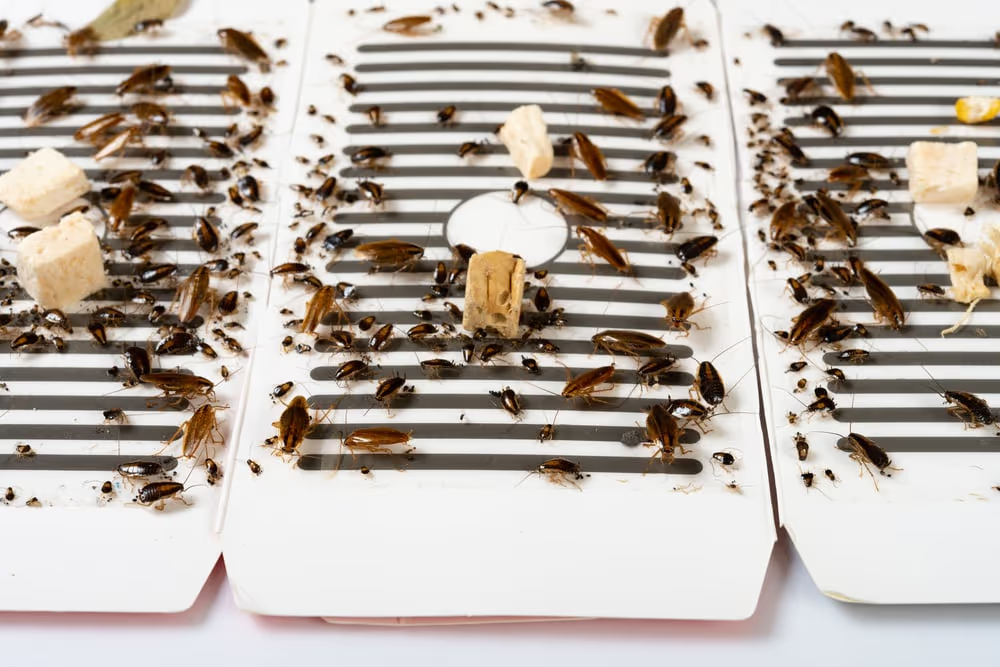
Sticky trap sheets with many catches. How to read what yours show is below.
A catch log kept over a couple of weeks can suggest:
- One adult, once, then nothing. Possibly a single cockroach carried in with groceries or boxes, or wandering in from outside. Keep a trap in place and keep watching.
- Catches that keep coming in the same spot. Cockroaches are probably living nearby. The trap with the most catches points to the area to inspect first.
- Small nymphs (young cockroaches) on the trap. This suggests breeding is happening indoors, a sign that traps alone are unlikely to solve the problem.
- Catches in several rooms or in a shared wall. The population is spread out, and in an apartment it may involve neighbouring units.
A catch cannot tell you how many cockroaches you have in total, or where they are hiding. Write down the date, the trap, and the number and size of cockroaches caught. That record is useful to you and to anyone you call to inspect.
Why traps alone rarely clear an infestation
A trap catches only the cockroaches that happen to cross it. Those sheltering in wall gaps and the eggs still inside egg cases are not reached, so the population can keep rebuilding while the trap fills. That is why Health Canada pairs monitoring with cleaning, moisture control, sealing and, where needed, registered pesticides used as the label directs.
Traps are also useful after a treatment. Ask your technician whether to keep monitoring traps in place, and where. Catches that fall over the following weeks are one simple sign treatment may be working; catches that do not fall are worth reporting back.
Questions to ask before anyone treats
- Which cockroach species is it, and does that change the treatment?
- Where is the harbourage, and what in the home is giving them food, water and shelter?
- What products will be used, where, and what do I need to do before and after the visit?
- Will there be a follow-up, and how will we know the problem is gone?
If your traps keep catching cockroaches, or you are catching nymphs, the cockroach control service in Vancouver starts with an inspection to find where they are living and which species you have.
Free Pest Control Quote
A reply the same day, or within 24 hours if you call after hours.