
Possible Termites in a Vancouver Home: Signs, Lookalikes and When to Book an Inspection
Short answer: Termites do live on the BC coast, but most things that look like termite damage are something else, usually water damage, rot or carpenter ants. Mud tubes on a foundation wall, discarded wings near a window, or timber that sounds hollow are good reasons to book an inspection. They are not proof. Only an inspection of the actual wood can tell you which of these you have.
Which termites live here
Two termites matter most on the BC coast: the western subterranean termite (Reticulitermes hesperus) and the Pacific dampwood termite (Zootermopsis angusticollis). According to the UBC e-fauna notes on BC termites, the subterranean termite lives mostly on the south coast and in the dry interior, and the Pacific dampwood termite is common on the coast. A third species, the dark dampwood termite (Z. nevadensis), is found from the coast to the interior of southern BC.
They behave differently, and that changes what to look for:
| What to compare | Western subterranean | Pacific dampwood |
|---|---|---|
| Needs | Soil, or earthen shelter tubes between soil and wood to keep the galleries moist | Wood in contact with the ground or with a continual source of dampness; does not build shelter tubes |
| Typical sign | Mud tubes on foundation walls, piers or crawlspace posts | Smoother galleries, often packed with fecal pellets, in damp timber |
| Where it turns up | Wood near or touching the ground | Leaking window framing, decks, fence posts, long-damp structural wood |
Signs worth acting on
- Earthen tubes running up a foundation wall, pier or crawlspace post.
- Piles of discarded wings near a sill or window after a swarm.
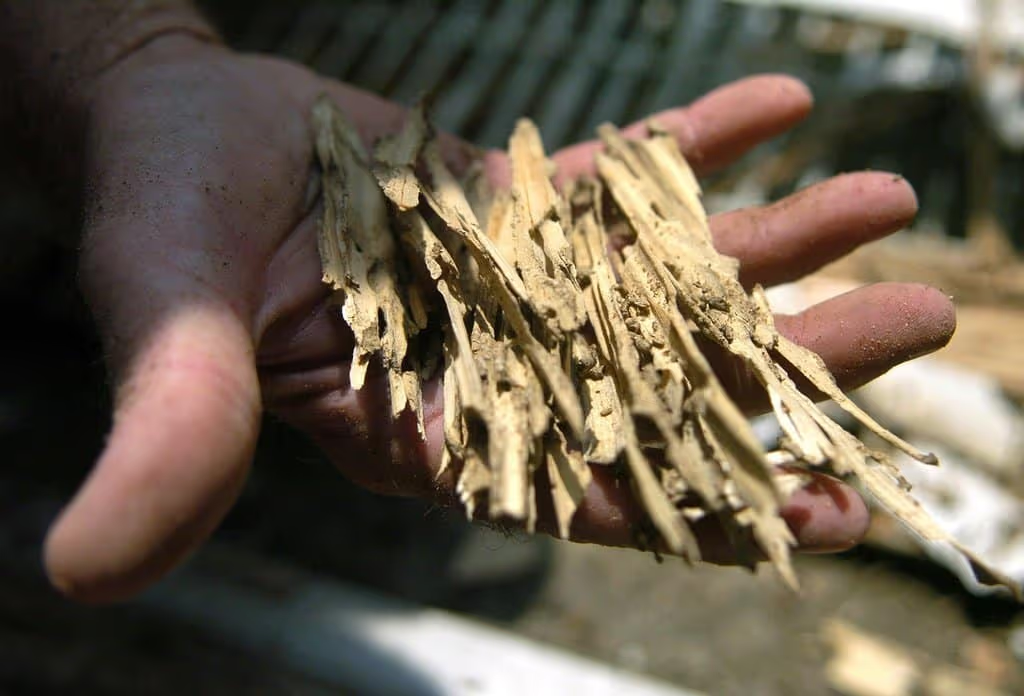
- Wood that sounds hollow when tapped, or that gives way to light pressure from a screwdriver.
- Paint that blisters or ripples over a flat surface, or doors and windows that start to stick.
Photograph what you find, note exactly where it is, and leave it in place. Breaking open a mud tube or spraying a suspected gallery can hide the evidence a technician needs.
What it might be instead
- Carpenter ants. Winged ants and winged termites are often confused. Termites have straight antennae, a thick waist and wings of equal length. Ants have elbowed antennae, a pinched waist and longer front wings. Health Canada notes that carpenter ants throw wood out of the nest as sawdust-like shavings. See our carpenter ant guidance if that fits.
- Rot or ordinary water damage. Soft, discoloured, damp wood has many causes, and the moisture is the problem to fix either way.
- Other wood-boring insects. Some leave fine powder or small round exit holes. Each needs a different response.
What an inspection can and cannot settle
A pest inspection can identify the insect, show where activity is, and point to the moisture or wood-to-ground contact that is feeding it. It is a visual assessment, so it cannot see inside closed walls, and it does not assess whether a structure is sound. If you are worried about structural strength, that is a separate question for a building professional.
Prevention that does not need pesticides
Both local species depend on moisture, so most prevention is moisture control:
- Keep soil, mulch and garden beds below siding level and away from framing.
- Break wood-to-ground contact: fence posts, deck supports and planters set into soil.
- Point gutters and downspouts away from the foundation, and fix leaks promptly.
- Keep crawlspaces ventilated, and store firewood and cardboard off the ground and away from the house.
Do not apply liquid soil treatments yourself. Products and methods for termites vary with the species and the building, and a wrong guess wastes money without protecting the structure.
Book an inspection
If you have found any of the signs above, our termite inspection and control service in Vancouver starts with an inspection to identify the insect before any treatment is proposed. Call (604) 229-1097 (8 AM to 8 PM, Monday to Sunday) or ask for a .
Free Pest Control Quote
A reply the same day, or within 24 hours if you call after hours.