
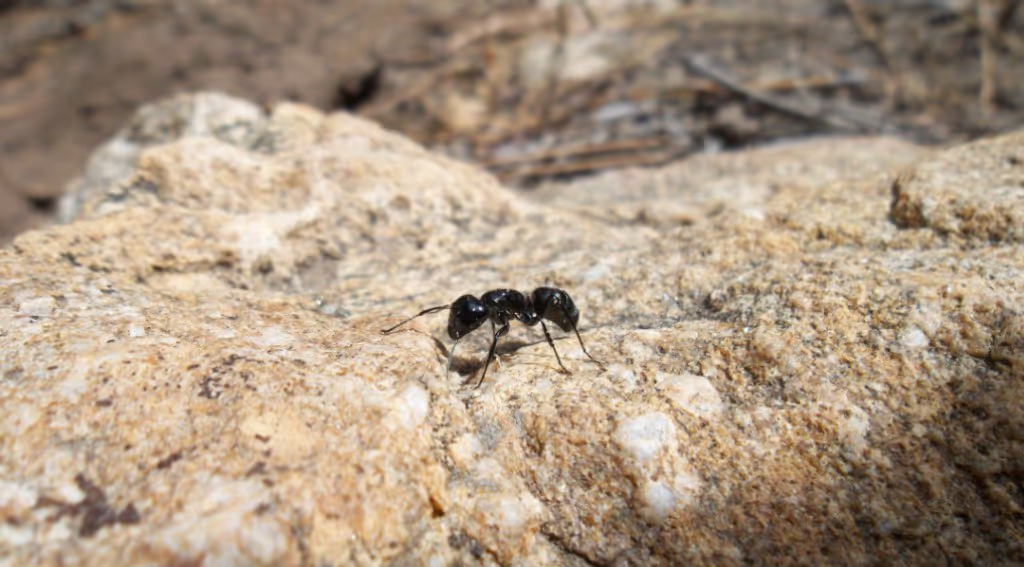
Carpenter Ants in Your Home: Nesting or Just Foraging?
Short answer: A few large ants seen occasionally can be foragers from a nest outdoors. Winged ants indoors, piles of sawdust-like frass, or ants that keep appearing in the same place point to a nest in or near the building. You cannot confirm a hidden nest from sightings alone, and an inspection is the reliable way to settle it.
First, are they carpenter ants?
Carpenter ants are among the largest ants you are likely to see indoors. They are identified by body shape rather than colour: a single bump (node) between the thorax and abdomen, and an evenly rounded thorax in side view. Other ant species typically look different in these features, which usually needs a hand lens to check. Photograph the ant on a plain surface to compare, or bring it to someone who can identify it.
Ants versus termites. A pinched waist and elbowed antennae distinguish ants, including winged ones, from termites. This matters because carpenter ants do not eat wood and generally do not damage it as much as termites do, but the two need different responses.
Signs that point to foraging only
- Occasional ants near food or water, with no pattern in where or when
- No frass anywhere
- Activity that eases when you remove food and moisture, which suggests foragers rather than a nest
In general, carpenter ants are most active at night in warm weather, so a lone ant in the evening does not tell you much; timing varies by species and region. Use a flashlight at night to follow trails along fences, branches or wires.
Signs that point to a nest
- Frass. Small piles of sawdust-like material. It looks like wood shavings or other excavated material with tiny fragments of dead ants and other insects, usually pushed out of a small hole in the nest chamber. Frass is a good sign that a nest is nearby.
- Winged ants indoors. Winged ants indoors generally mean a nest is in the structure. Winged ants seen only outdoors tell you less about your building.
- The same trail or place, repeatedly. Ants coming and going from one gap, window frame or baseboard.
- Damp or soft wood nearby. They favour existing cavities or softer materials, especially near a moisture source. A leak is worth fixing for its own sake.
What you see, what it usually means, and what to do
| What you see | What it usually means | What to do |
|---|---|---|
| A few large ants now and then, no pattern | Foragers from a nest, often outdoors | Remove food and moisture, keep a log |
| Sawdust-like frass | A nest is probably nearby | Photograph it, note where, and book an inspection |
| Winged ants indoors | A nest is likely in the building | Book an inspection |
| The same trail or gap, again and again | A nest close to that spot | Log it and call |
| Soft or hollow wood | Possible nest or moisture damage | Fix any leak and call |
Keep a short observation log
Write down the date, time, room, number of ants, whether they have wings, and whether you see frass. A week or two of notes separates a one-off from a pattern, and is what an inspector will ask for. Photograph frass on a dark sheet of paper placed under the area.
What you cannot tell from outside
Not seeing frass does not rule out a nest, and frass can fall into wall voids where you cannot see it. A nest may be outdoors, indoors, or both, and there can be more than one. This is why wall-drilling and dust or foam instructions found online are not advice we give: they risk damaging the structure, may involve wiring and plumbing, and use pesticides in ways that depend on the product label. Do not drill into walls or spray into them.
When to call
- Winged ants indoors, or frass in more than one spot
- Ants returning to the same place after you remove food and moisture
- Soft, damaged or hollow wood
- You cannot tell what kind of ant it is
The surest way to deal with carpenter ants is to find and treat the nest or nests, as this carpenter ant fact sheet explains. Pesticon's carpenter ant control in Vancouver begins with what the inspection finds. Bring your log and photos.
Free Pest Control Quote
A reply the same day, or within 24 hours if you call after hours.