
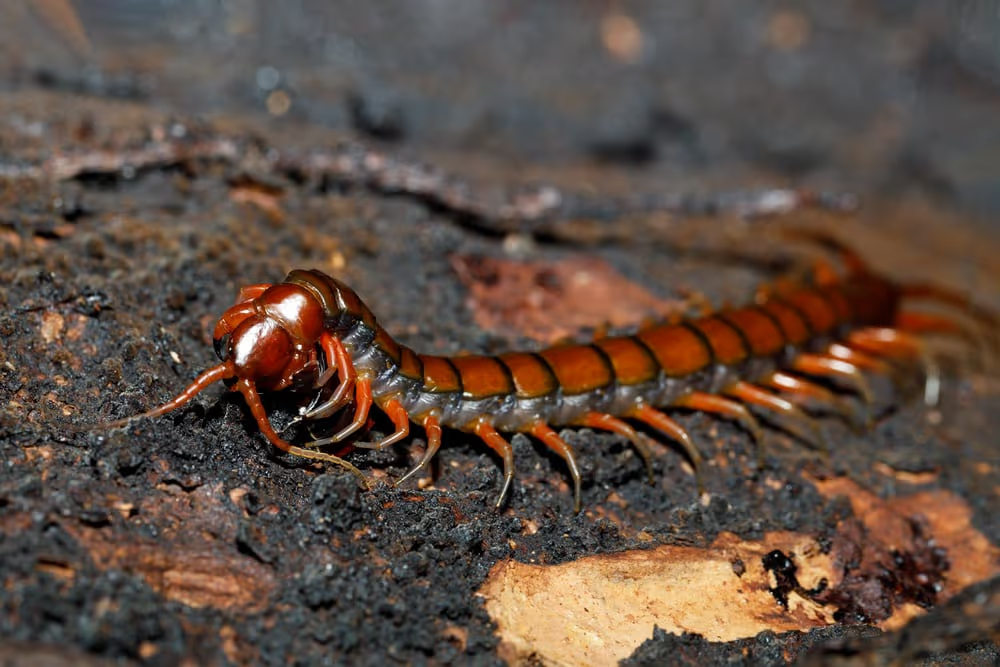
House Centipedes: How to Identify One and When It Matters
A house centipede indoors is usually a sign of damp conditions and other insects to eat, not of a hidden infestation. One or two sightings need no treatment. Regular sightings are a reason to look at moisture and at what the centipedes are feeding on.
How to recognize a house centipede
- Body about 2.5 to 5 cm long (1 to 2 inches), brownish or greyish-yellow, often with three dark stripes down the back.
- 15 pairs of long, banded legs. The last pair can be more than twice the length of the body.
- A pair of very long, slender antennae pointing forward.
Other centipedes and millipedes are sometimes found indoors. Centipede legs are attached at the sides of the body, which lets them run much faster than millipedes, according to Ohio State University Extension. If you are unsure what you have, photograph the animal beside a coin so the size is clear.
Why it is there
Centipedes lose water easily because their outer skin lacks the waxy coating many insects have, so they need moist places. The house centipede is often found in basements and bathrooms. They also hunt other small animals, and the University of Minnesota notes that seeing many house centipedes means there are other insects in the home for them to eat.
So a regular visitor points to two questions: where is moisture getting in, and what are they hunting?
Bites
Bites are rare. The University of Minnesota says the house centipede is shy and its jaws are too small to get through human skin. Larger centipedes (over 5 cm, or two inches) can bite, though rarely, with short-lasting swelling or pain. If someone has a reaction that worries you, call HealthLink BC at 8-1-1.
No-treatment-needed versus inspection
No treatment needed: an occasional centipede in a bathroom or basement. Remove it, and fix any obvious damp.
Worth an inspection: repeated sightings in the same area over several weeks, sightings alongside other insects (silverfish, cockroaches or similar), or persistent dampness you cannot trace.
A moisture and recurrence checklist
- Dehumidify basements and damp rooms; run bathroom fans.
- Fix leaks and condensation on pipes.
- Move firewood and stored cardboard away from living areas.
- Seal gaps around pipes, foundations and door thresholds.
- Note where and how often you see them, so you can tell a one-off from a pattern.
- Look for the insects they eat. If you find another pest, deal with that first.
If you book an inspection, useful questions are: where is the moisture coming from, what else in the home are they feeding on, and what would you check again if the sightings continue?
If sightings continue after you have dried out the space, or you find the insects they feed on, see our pest control services in Vancouver.
General information, not medical advice. For a sting, bite or exposure reaction, call HealthLink BC at 8-1-1, or 9-1-1 in an emergency.
Free Pest Control Quote
A reply the same day, or within 24 hours if you call after hours.