
Bee, Yellowjacket, Paper Wasp or Hornet? How to Tell Them Apart
Look at the nest and the behaviour as much as the insect. Nest shape and where insects go will usually tell you more than size or colour.
Quick comparison
| Insect | Nest or behaviour clue | Leave alone? |
|---|---|---|
| Honey bee | Furry, rounder body; may rest as a hanging cluster (swarm) | Usually yes. Call a beekeeper for a swarm (City of Vancouver) |
| Bumble bee | Large, furry; nests in the ground; generally gentle; a colony usually does not reuse its nest site the next year | Often yes |
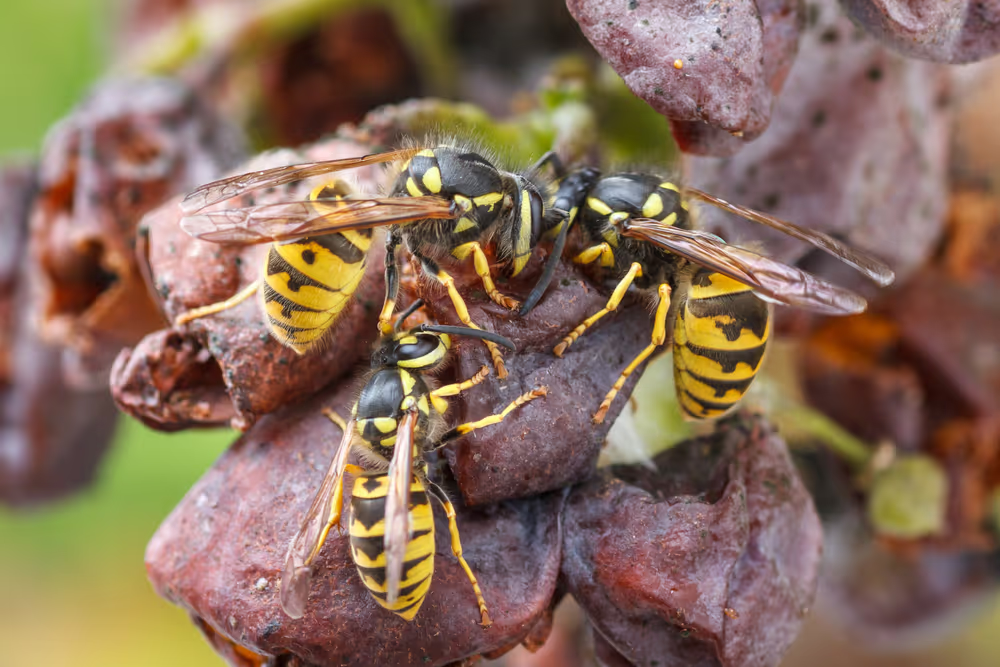
| Yellowjacket | Sleek yellow-and-black; common at food; Simon Fraser University (SFU) describes 3 to 5 common ground- or cavity-nesting species in southwest BC, with nests holding thousands of workers | Not if the nest is near people |
| Paper wasp | Slender with long legs; open, umbrella-like comb of cells | Sometimes: depends on location |
| Bald-faced hornet | Black and white; grouped by SFU with the aerial yellowjackets; exposed paper nest on eaves or in tree branches | No, if close to people |
| Asian giant hornet | Up to 5 cm long, distinct shield-shaped head; ground nests (BC pest alert, 2021) | Report; do not approach |
SFU notes that the name "hornet" is used both for true hornets, such as the European hornet established in eastern North America, and for the aerial yellowjackets such as the bald-faced hornet.
Nest shapes
- Umbrella-shaped nest of open cells under an eave, railing or deck: paper wasp.
- Grey paper ball or lantern hanging from a branch or eave: bald-faced hornet or aerial yellowjacket (SFU).
- Insects entering a ground hole or wall gap: yellowjacket or bumble bee; look at the insects.
- A hanging cluster of bees with no comb: a honey bee swarm.
Many wasps flying to one spot usually means a nest nearby, and a nest is defended. A honey bee swarm is not defending a nest and is generally docile (City of Vancouver).
Behaviour and when to leave it alone
Insects visiting flowers, drinking at a tap or passing through are usually no cause for action. Do not disturb a nest; do not swat. Leave an insect alone when it is foraging, no nest is near people and nobody at home has a severe sting reaction.
A nest next to a door, in a wall, or visited repeatedly by many insects should be assessed. See paper wasp nest: leave it or get it assessed? or suspected hornet nest.
Photos help
Take a photo from a distance with zoom, of the insect on its own and of the nest. If you ask a provider for help, send both.
For an assessment, see our wasp control service in Vancouver.
General information, not medical advice. For a sting, bite or exposure reaction, call HealthLink BC at 8-1-1, or 9-1-1 in an emergency.
Free Pest Control Quote
A reply the same day, or within 24 hours if you call after hours.