
Signs of Rats in the Roof or Attic: What You Can Check Safely and When to Call
Short answer: You can look for signs of roof-level rodents from the ground and from inside the attic hatch, but the roof itself is for a professional. If you hear activity overhead, do not seal the roofline until you are sure nothing is inside. A sealed-in animal can die in the structure.
Rats that live at roof level are most often roof rats, which the City of Vancouver lists with the Norway rat and the house mouse as the common rodents in the area. A noise in the ceiling does not prove it, though. Other animals live in roof spaces too, so the useful question is what evidence you have and what to do next.
What you can observe from the ground
Look at the building from the street and the yard, in daylight, without climbing.
- Overhanging branches, ivy and wires touching the roofline or walls. Roof rats are agile climbers. University of California pest guidance on the same species notes they are often seen at night running along overhead utility lines or fence tops, and advises removing tree limbs within 6 feet (about 2 m) of a roof to keep rats and tree squirrels off it.
- Gnawed or damaged soffit, fascia or vent screens. Look for chewed edges and pulled-out screens.
- Dark rub marks on beams, rafters, pipes and walls. UC IPM describes these smudge marks as caused by rats rubbing their fur against those surfaces.
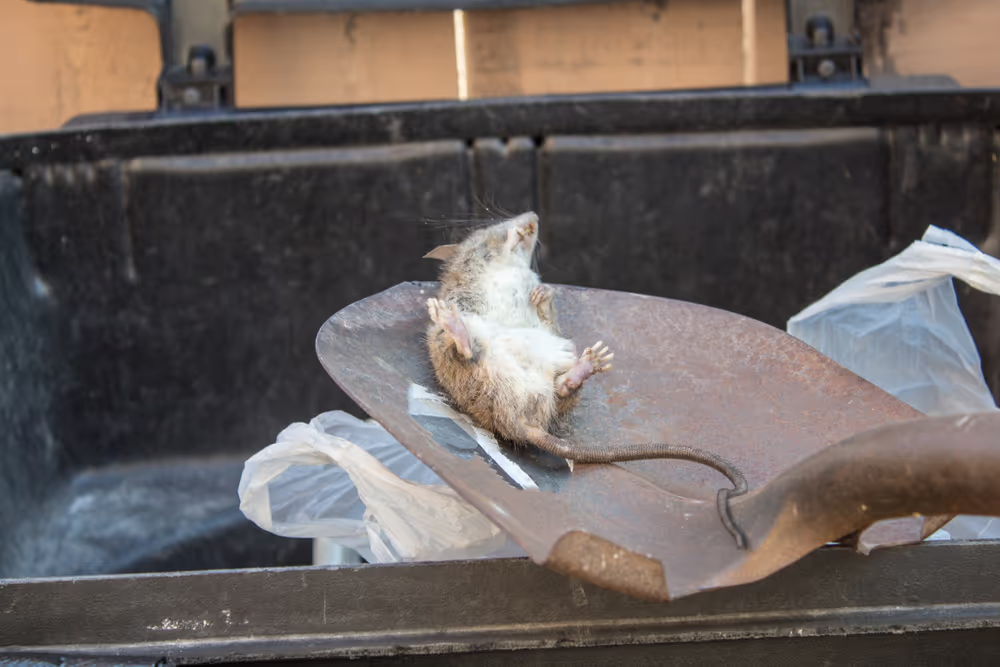
- Droppings on the ground, on flat roof sections you can see from a window, or on the attic floor. HealthLink BC puts roof rat droppings at about 13 mm (1/2 inch) with pointed ends, larger than mouse droppings (about 6 mm). Photograph, do not handle.
- Activity at dusk along fences and wires. UC IPM lists rats travelling along utility lines or fence tops at dusk as a sign, and the City of Vancouver notes rats and mice are more active at night.
You can look inside the attic only if the hatch is easy and safe to reach. Stay on the ladder and use a torch. Do not walk on insulation or ceiling boards, and do not disturb droppings or nesting material. Wear gloves and a well-fitting mask if you must go near it, and read the clean-up steps in HealthLink BC File #37.
What it could be instead
Noises from above have more than one cause:
- Squirrels can also reach a roof from overhanging trees, as UC IPM notes. Our guide to raccoons and squirrels in attics covers them.
- Raccoons and mice can also be responsible for noise in a roof space.
- Noise alone does not identify the animal. Health Canada lists scampering and scratching sounds in the walls at night as a sign, but a second sign (droppings, rub marks, gnawing) is what makes it evidence.
If you cannot tell which animal is in the roof, that is a reason to ask for an inspection, not to guess. For rats versus mice, see mice versus rats.
Why the roof comes with extra risks
- Working at height. A fall is a bigger risk than the rodents.
- Occupied attics. If animals are present and you seal the entry, they may stay inside. HealthLink BC warns that poisoned rodents die where they cannot be found, and the same problem applies to a rodent trapped in a roof space.
- Hidden damage. Chewed wiring and soiled insulation cannot be seen from outside. Do not assume the inside is intact because the outside looks fine.
- Entry gaps are small. Health Canada says mice enter through cracks as small as a dime and rats through a hole the size of a quarter; HealthLink BC advises sealing openings larger than 6 mm (1/4 inch). A quarter-sized hole is easy to miss from the ground.
Do repellents work?
Do not rely on them. HealthLink BC says ultrasonic repellers are costly and "do not have long-term success at eliminating rodents". Peppermint oil, mothballs and ammonia are not proven ways to clear a roof infestation, and mothballs and ammonia are not made for use in an attic, so do not put them there.
When to call a professional
Ask for an inspection if:
- you hear activity overhead on more than one night, or at any time of day you cannot explain
- you find droppings, rub marks or gnawing at roof level, or on the attic floor
- the entry is on the roof, a chimney, a vent or at a height you cannot reach safely
- you have already sealed or trapped and the signs return
Before the visit, collect: dated photos, the noise pattern (time of night, how long, where), where any droppings are, and any trees or wires touching the building. Pesticon's mice control page explains how to book.
Free Pest Control Quote
A reply the same day, or within 24 hours if you call after hours.